


Text | Da He
On September 30, the Ministry of Civil Affairs finally released the 2025 statistical bulletin on the development of civil affairs.
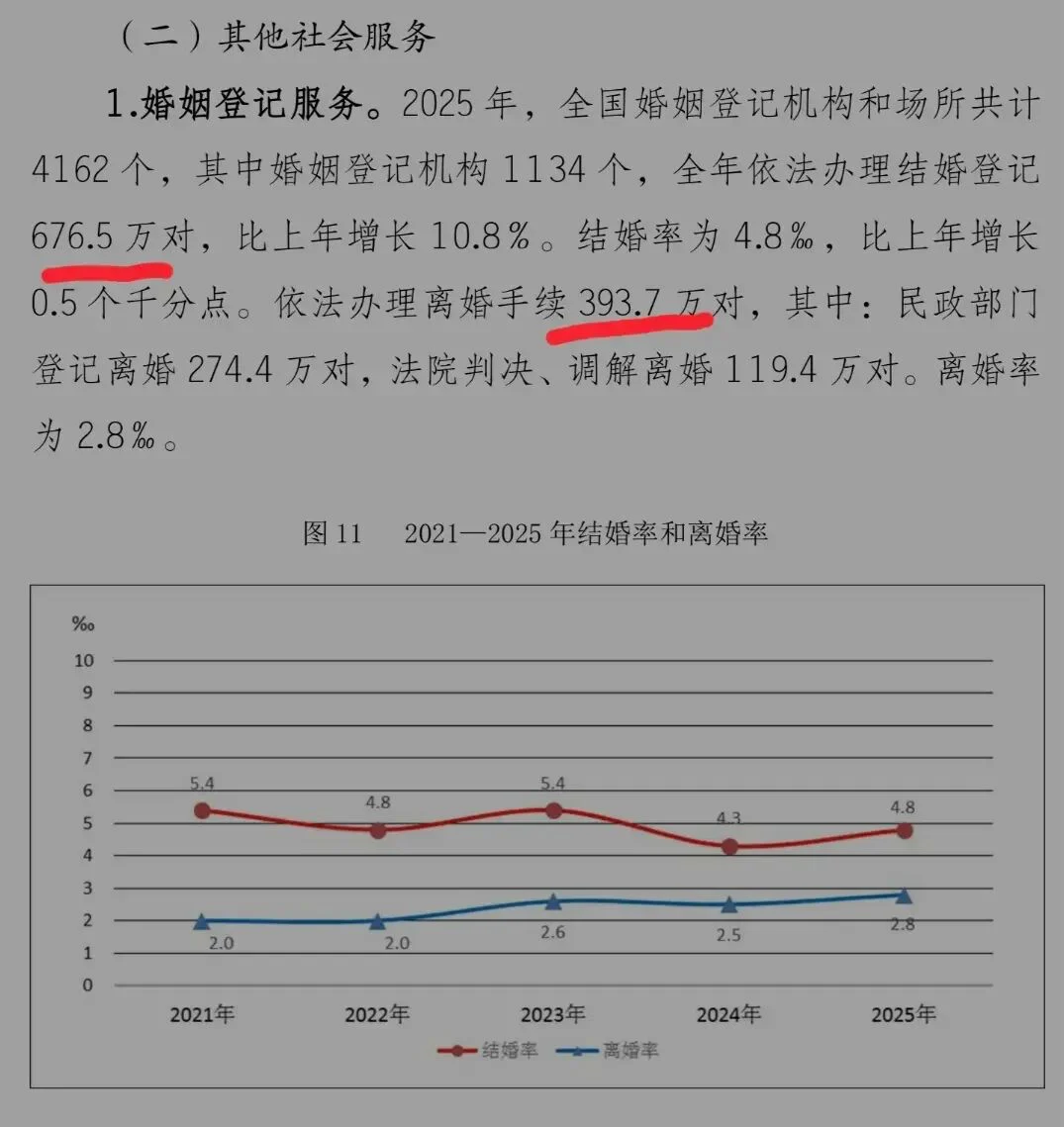
Last year, there were 6.765 million marriage registrations nationwide, an increase of 10.8% compared to 2024. The marriage rate was 4.8‰, also 0.5 per thousand points higher than the previous year.
Looking at this double-digit growth rate alone, it does seem quite good.
What's a bit awkward is that this is good news from 2025, and the fourth quarter of 2026 had already begun when it was released.
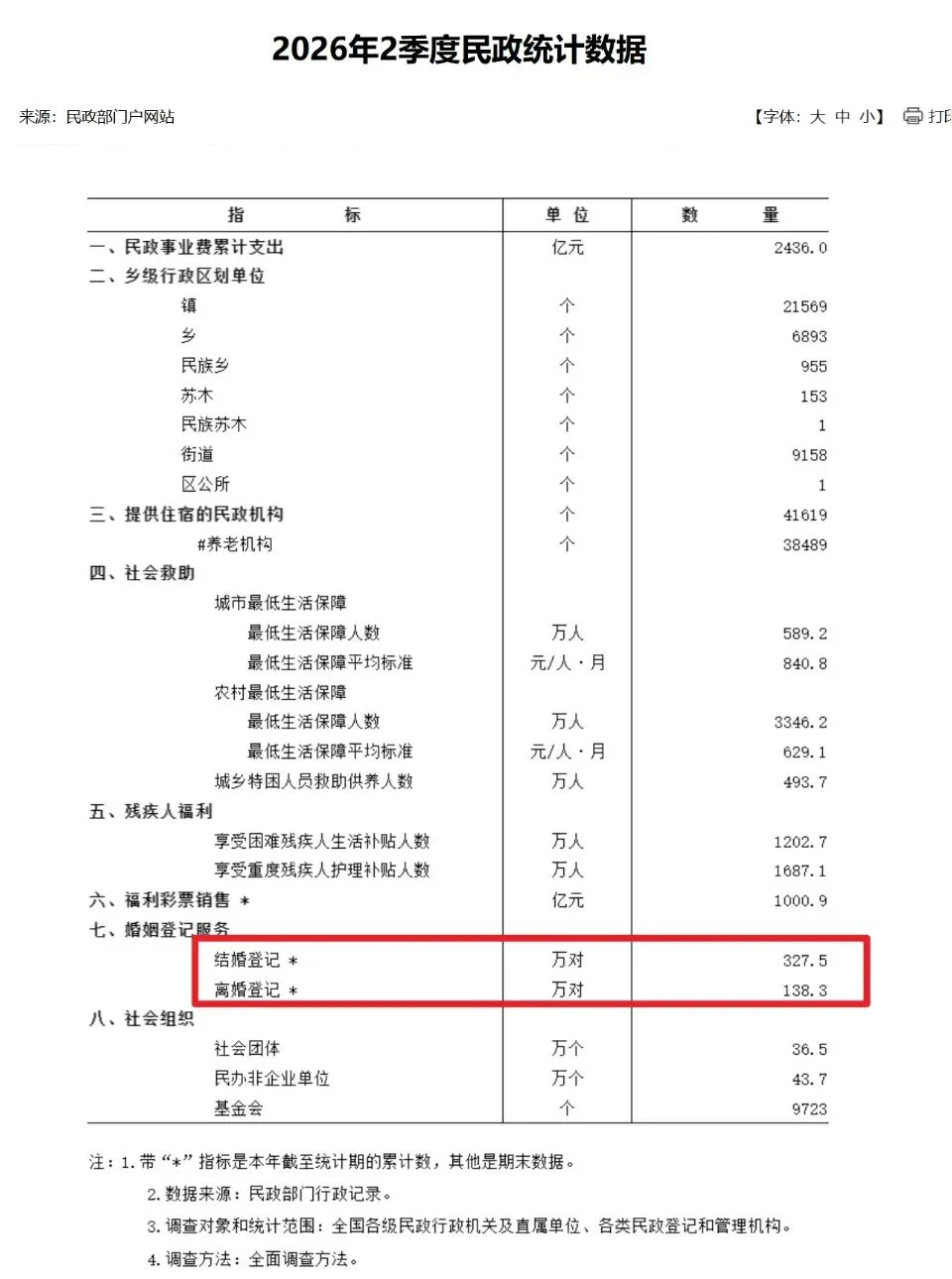
Secondly, the marriage data for the first half of this year was already released in August.
3.275 million couples, a decrease of 264,000 couples year-on-year, down 7.46%, and even 155,000 couples less than the 3.43 million couples in the first half of 2024.
It's still too early to say whether the full year will set another record low.
Let's first see how this 10.8% increase in 2025 came about.
A fairly intuitive reference point is 2022.
In 2022, there were 6.835 million marriage registrations nationwide, with a marriage rate of 4.8‰.
In 2025, there were 6.765 million couples, and the marriage rate was still 4.8‰.
After three years of ups and downs, with significant increases and decreases, we have basically returned to the position of 2022.
In fact, 2023 saw an even stronger increase than last year.
In that year, marriage registrations increased from 6.835 million couples to 7.682 million couples, a year-on-year increase of 12.4%, which was the first rebound in nearly a decade.
By 2024, it dropped directly to 6.106 million couples, a decrease of 20.5%.
Then, in 2025, it increased by 10.8% again.
6.835 million couples in 2022, 7.682 million couples in 2023, 6.106 million couples in 2024, and 6.765 million couples in 2025.
The marriage data in recent years has been like a roller coaster.
If we look back a bit further, in 2013, there were still 13.469 million couples nationwide.
Twelve years later, only about half remain.
As the denominator gets smaller, an increase or decrease of tens of thousands of couples per year can easily result in double-digit percentage changes.
In 2025, there were 659,000 more couples than in 2024, which is 10.8% based on the low base of 6.106 million couples.
Compared to the scale of 2013, it's actually less than 5%.
Therefore, although the increase of 659,000 couples in 2025 looks like a large growth rate, it hasn't even returned to the level of 2023, still falling short by 917,000 couples.
There is another detail in the full-year data for 2025.
The first half of the year didn't actually increase much.
In the first half of 2024, there were 3.43 million marriage registrations, and in 2025, there were 3.539 million, an increase of only 109,000 couples, a growth of about 3.2%.
In the second half of the year, the gap suddenly widened.
In the second half of 2024, there were 2.676 million couples, and in the second half of 2025, there were 3.226 million, an increase of 550,000 couples, a growth of over 20%.
The total increase for the year was 659,000 couples, of which 550,000 occurred in the second half, accounting for over 80%.
I believe a major reason is the policy push. Starting May 10, 2025, the newly revised “Regulations on Marriage Registration” came into effect, removing regional restrictions for marriage registration, allowing nationwide processing, and no longer requiring household registration books.
Previously, if two people worked in different places, they had to consider whose household registration location to return to, take time off, buy tickets, and go through the hassle.
Now, these troubles are greatly reduced.
Localities have indeed been quite diligent last year.
Marriage leave is getting longer, some places offer marriage bonuses and consumption vouchers, and marriage registration points have moved from traditional civil affairs bureaus to parks, scenic spots, shopping malls, banks (and even bars); later, even highway service areas had them.
There are not many new places left to refresh the marriage registration points.
There is another number in the bulletin that can be easily misunderstood.
Among the married population in 2025, those aged 25 to 29 were the most numerous, with 4.99 million people, accounting for 36.88%. This age group has ranked first for 13 consecutive years.
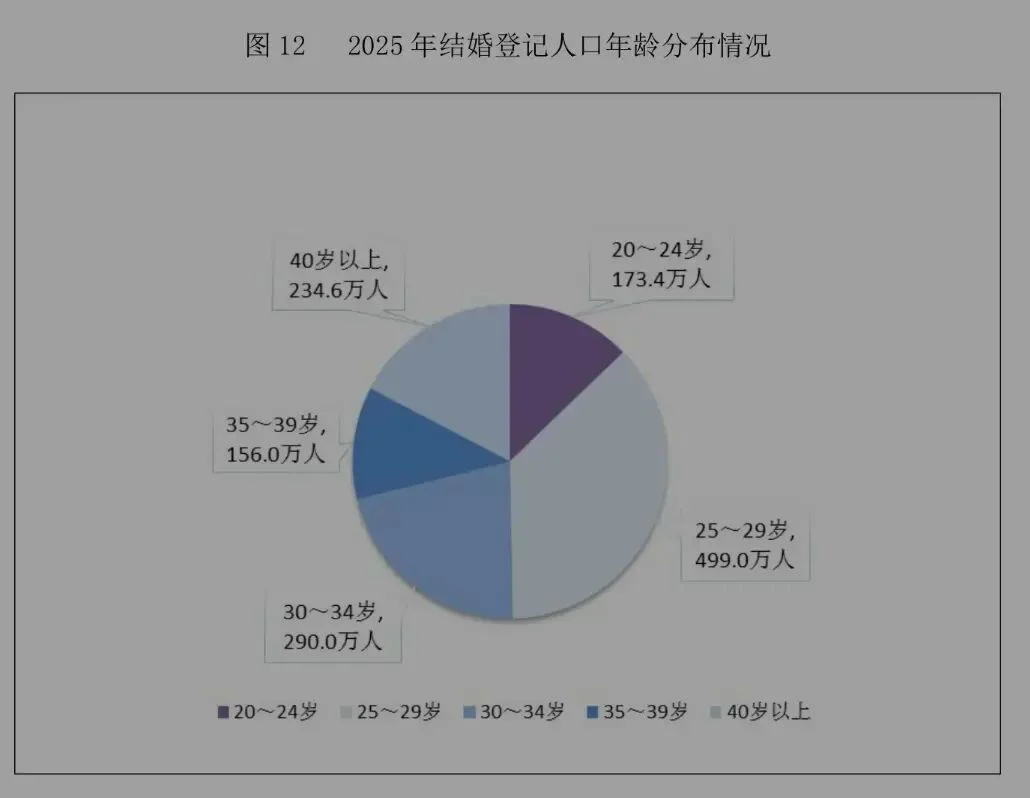
In 2024, it was 4.288 million people, accounting for 35.1%.
This means that the 25 to 29 age group increased by 702,000 people in one year.
Last year, national marriage registrations increased by 659,000 couples compared to 2024, which translates to an increase of 1.318 million people.
Roughly calculated, more than half of the newly married population comes from the 25 to 29 age group.
At least it can be seen that the rebound in 2025 is not just a good overall figure; there has indeed been an increase in the traditional prime marriage age group.
But there is an old problem here.
4.99 million people accounting for 36.88% of the married population refers to the proportion of people aged 25 to 29 among those who are already married.
It does not tell us how many of all young people aged 25 to 29 in the country got married in this year.
Different denominators lead to different conclusions.
The population in this age group itself is decreasing, yet its proportion remains the highest, which can occur simultaneously with a continued decline in the total number of marriages.
So, the statement “the 25 to 29 age group has had the most marriages for 13 consecutive years” is certainly correct, but using it to prove that young people are newly enthusiastic about marriage, I personally feel, goes a bit too far.
The same bulletin contains another set of data that is quite suitable for viewing alongside the 10.8%.
In 2025, 3.937 million couples legally completed divorce procedures nationwide, compared to 3.513 million in 2024, an increase of 424,000 couples in one year, a growth of approximately 12.1%.
The divorce rate also rose from 2.5‰ to 2.8‰.
Of course, one cannot directly divide 3.937 million couples by 6.765 million couples.
The people divorcing this year may have married ten or twenty years ago; these two groups are not the same at all.
However, if we were to announce an improvement in people's confidence in marriage based solely on the 10.8% increase in marriage registrations, the divorce figures from the same bulletin would make this conclusion seem a bit hasty.
The policies regarding marriage in recent years have actually been quite considerate regarding the process of obtaining a marriage certificate.
Nationwide processing, no need for household registration books, extended marriage leave, more registration locations, and some places even offering cash or consumption vouchers.
These things have practical benefits for those who are already planning to get married.
Taking one less day off, saving a trip back to one's hometown, getting a few extra days of marriage leave, and conveniently receiving any offered money – no one would refuse these.
But the marriage certificate itself has never been the most expensive part of a marriage.
Getting the certificate doesn't cost much.
The truly expensive and time-consuming matters come after obtaining the certificate.
How to solve the housing issue, how to negotiate the bride price and wedding expenses, whether to have children and who will be responsible for raising them, what to do about the parents of both sides in the future, and whether work and income can support a family.
These issues cannot be resolved no matter where the marriage registration office is moved.
The 10.8% in 2025 can certainly be considered good data for the year.
Just don't be too hasty in naming it a “bottoming out and rebound” for now.
It also rose by 12.4% in 2023, and then fell by 20.5% the following year.
In the long-term trend, an abnormal data point is normal and doesn't explain much. Unless there are four or five consecutive years of growth, it cannot represent a trend reversal.
Often, we clearly know the facts in our hearts, but are emotionally unwilling to admit them.
But when reality hits us like a “south wall,” we realize this wall was built on the edge of a cliff.
What is that hardest “south wall”?
It's the demographic structure.
By 2025, the national average age of first marriage for men will reach 30.4 years, and for women, 28.6 years. The main group getting married now is largely those born in the mid to late 1990s.
At that time, around 20 million children were born each year.
In 1994, the birth population was about 21 million. After 1997, it began to decline significantly. Entering the 2000s, most years saw the figure drop to around 16 million.
Therefore, even if the willingness of young people to marry does not continue to decline in the future, as those born in the 2000s gradually become the main group for marriage registration, the total number of marriages will still be squeezed by the population base.
This is much harder to change than whether a year is a “double spring year” or if a few more marriage consumption vouchers are issued.
This means that in the next few years, the base of young people who are the main force in marriage will itself enter a period of rapid shrinkage.
When the denominator, the population of marriageable age, is rapidly shrinking, no matter what short-term policies we use to beautify the numerator, the long-term trend of this ratio is difficult to reverse.
We can't possibly rely solely on giving out eggs, can we?

End of article. Thank you for reading. Since you've read this far, if you found it helpful, please like, share, and click “in read”.
-end-
A final note: I've created a community group that has been running for two years. Friends with similar values are welcome to join.

Every day in the group, I share some of my observations and thoughts. You can also ask me questions, and we can progress together, enjoying the beauty of steady improvement~