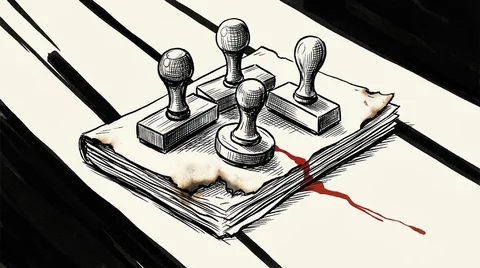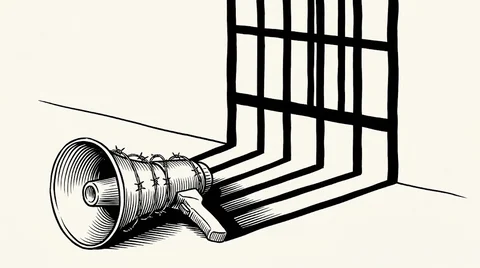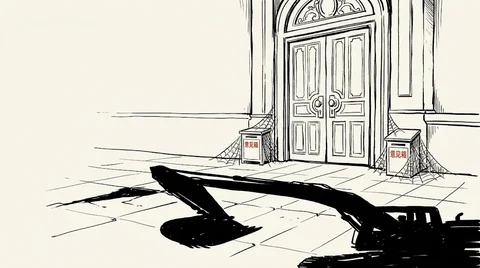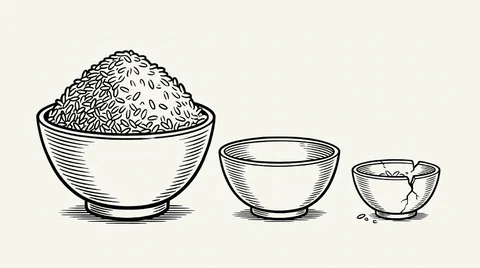


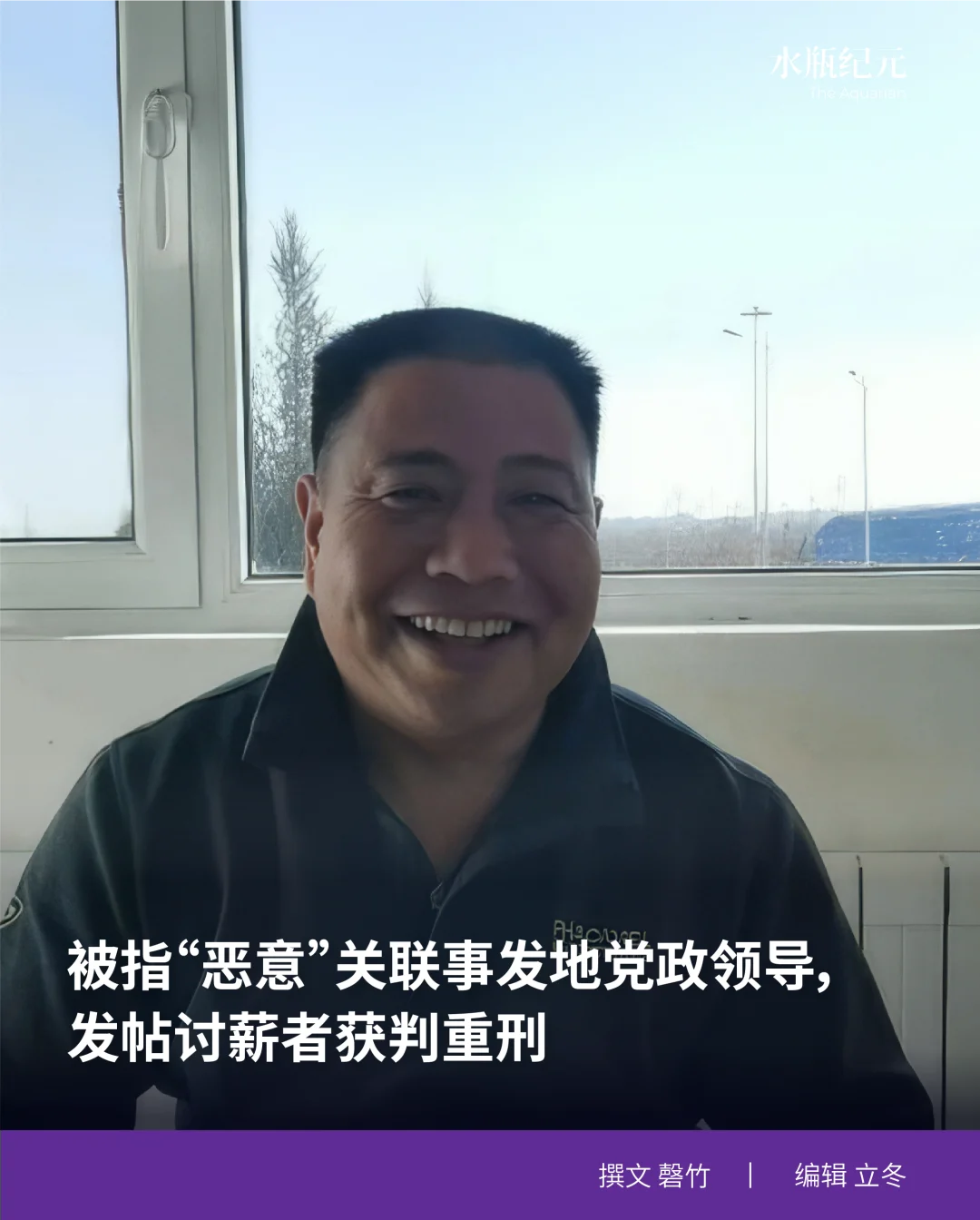
For posting online to help people ask for wages and mentioning local party and government leaders, self-media writer Zhou Lubao, migrant worker Jing Shuren, and several people asking for wages were sentenced to a maximum of 14 years in the first instance by a Lanzhou court on charges of picking quarrels and provoking trouble. When regular channels for rights protection are blocked, and people turn to the internet for help as a last resort, how did it turn into a criminal prosecution of “arrest first, file case later”, and even turn the wage debtor into a “victim”?
Lawyer Zhu Xiaoding still remembers that when he first met Jing Shuren in the detention center two years ago, the 50-year-old migrant worker was most concerned about the half-bag of rice left at the construction site and the unfinished instant noodles. With a monthly salary of 3,500 yuan, Jing Shuren only kept 200 yuan for himself and sent the rest home.
This is already the third year Jing Shuren has been imprisoned. Because he reposted a post asking for wages on Weibo, he was accused of the crime of picking quarrels and provoking trouble and has been detained since March 16, 2024, for over 970 days.
Jing Shuren is from Yuntian Town, Longxi County, Gansu Province, with a junior high school education, and is the youngest of six children in his family. Zhu Xiaoding once visited Jing’s father in Longxi and saw the old man living in a dilapidated house, usually collecting rainwater for drinking water. Jing Shuren dropped out of school early, with a junior high school education, but he remained concerned about social affairs. On the dusty construction sites, this dark-faced security guard would delve into his mobile phone, shouting for the same people at the bottom. He has posted over 250,000 Weibo posts, reposted whistleblower information, called for public attention to social events, and accumulated 72,000 followers.
Also detained with Jing Shuren were 6 others: self-media writer Zhou Lubao, Zhou Lubao’s sister Zhou Fangqin, and 4 actual individuals asking for wages. These 7 people had the labels of “mafia-related” and “evil-related” removed during the procuratorate’s review and prosecution stage, but their sentences in the first instance were not reduced. The main author of the posts, Zhou Lubao, was sentenced to 14 years, Jing Shuren, who sometimes reposted, was sentenced to 4 years, and the other 5 people were sentenced to between 2 years and 10 months and 4 years and 6 months.
“Good Person of Gansu” accused of “Picking Quarrels and Provoking Trouble”
The criminal detention of Jing Shuren surprised most of the Weibo big Vs who interacted with him frequently, but they also felt it was not entirely without warning.
Yu Fei, former deputy director of the Peking University Institute for the Study of Private Enterprises in China, once described him on Weibo as: “A simple and honest migrant worker, a hardworking person guarding the construction site gate, a netizen full of justice.” Shortly before his criminal detention, Jing Shuren, on his way back to his hometown, found a damaged water supply pipe by the provincial road and immediately called the highway and municipal departments to report the situation. That evening, he also received a thank-you text message from the relevant department. Yu Fei once wrote a poem praising him: “The world is full of ugly monsters, Shuren is brilliant. He hates evil as if it were his enemy, simple and truly lovely.”
Jing Shuren's straightforwardness and enthusiasm also made Yu Fei quite worried. Yu Fei posted on Weibo saying that Jing Shuren had told him that the local police station often advised him to mind his own business. Yu Fei had also advised him to consider his family more and to understand the limits of doing good deeds. Yu Jianrong, a professor at the Institute of Rural Development of the Chinese Academy of Social Sciences, also recalled in a Weibo post that he had advised Jing Shuren to pay more attention to his family: “A person who makes a living on construction sites, yet is keen on supervising and criticizing, will one day end up in jail.” Jing Shuren retorted: “If everyone stays silent, how will society function?” Yu Jianrong reminded him: “If you go to jail, what about your elderly father and young children?” Jing Shuren was silent for a long time and replied: “I still want to do something for the rule of law in this country.”
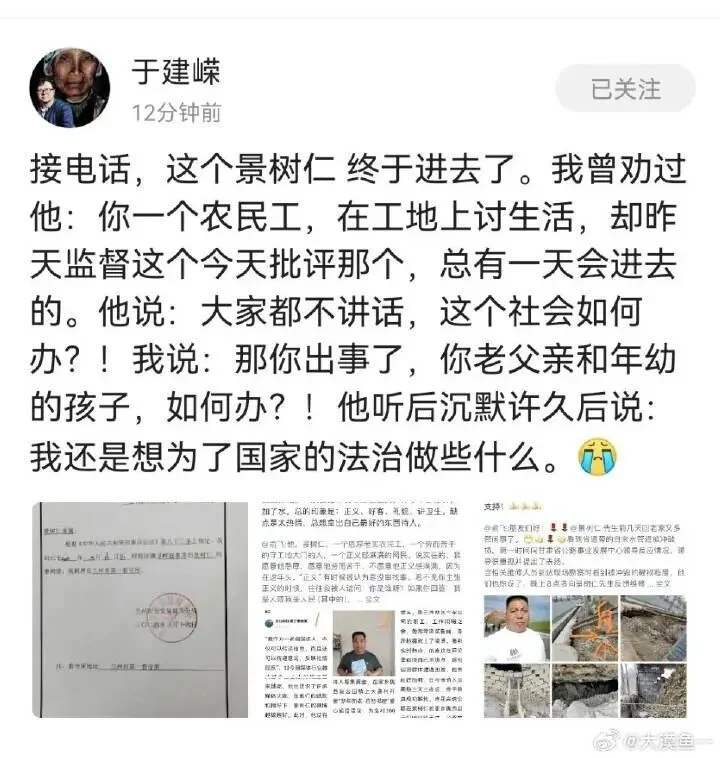
Yu Jianrong, a professor at the Institute of Rural Development of the Chinese Academy of Social Sciences, talks about his conversation with Jing Shuren (Image_Weibo screenshot)
On March 15, 2024, Jing Shuren was taken away by the Chengguan Branch of the Lanzhou Municipal Public Security Bureau. Also arrested on the same day were the “main culprits” Zhou Lubao and 6 other people. The investigating authorities initially transferred the 7 people for review and prosecution on charges of “organizing, leading, and participating in organized crime, extortion, picking quarrels and provoking trouble, and illegal business operations.” In March 2025, when the Chengguan District Procuratorate of Lanzhou City filed a public prosecution, it removed the charges of “organized crime” and “illegal business operations.” The day before the first trial, the procuratorial authorities withdrew the accusation of “evil forces group crime,” and the case was no longer considered “involving organized crime or evil forces.”
The public prosecution agency accused the 7 people of “repeatedly committing acts of picking quarrels and provoking trouble and extortion a total of 26 times” between January 2022 and January 2024, and additionally accused Zhou Lubao of committing one act of extortion alone.
Zhou Lubao is currently 41 years old and has a junior high school education. Publicly available information shows that he served in the army for four years, during which he worked as a news reporter. He rose to prominence in 2011 when “Weibo rights protection” was emerging. After successful cases of public rights protection by some influential Weibo users (Weibo big Vs) became widely circulated, more and more people began to use Weibo's “onlooker effect” to protect their rights by recounting personal experiences. Zhou Lubao accumulated experience in online operations and forum moderation by writing articles and serving as a moderator on various online forums in his early years. In the Weibo era, he transformed into a “net whistleblower” with millions of followers. In December 2012, Zhou Lubao reported in his real name that Yuan Zhanting, then the mayor of Lanzhou, wore multiple luxury watches, and “watch brother” became a hot term in Weibo anti-corruption campaigns. In 2015, Zhou Lubao was accused of extorting businesses, scenic spots, and temples by threatening negative exposure, and was sentenced to five years in prison by a Suzhou court for extortion. He was released from prison in 2018.
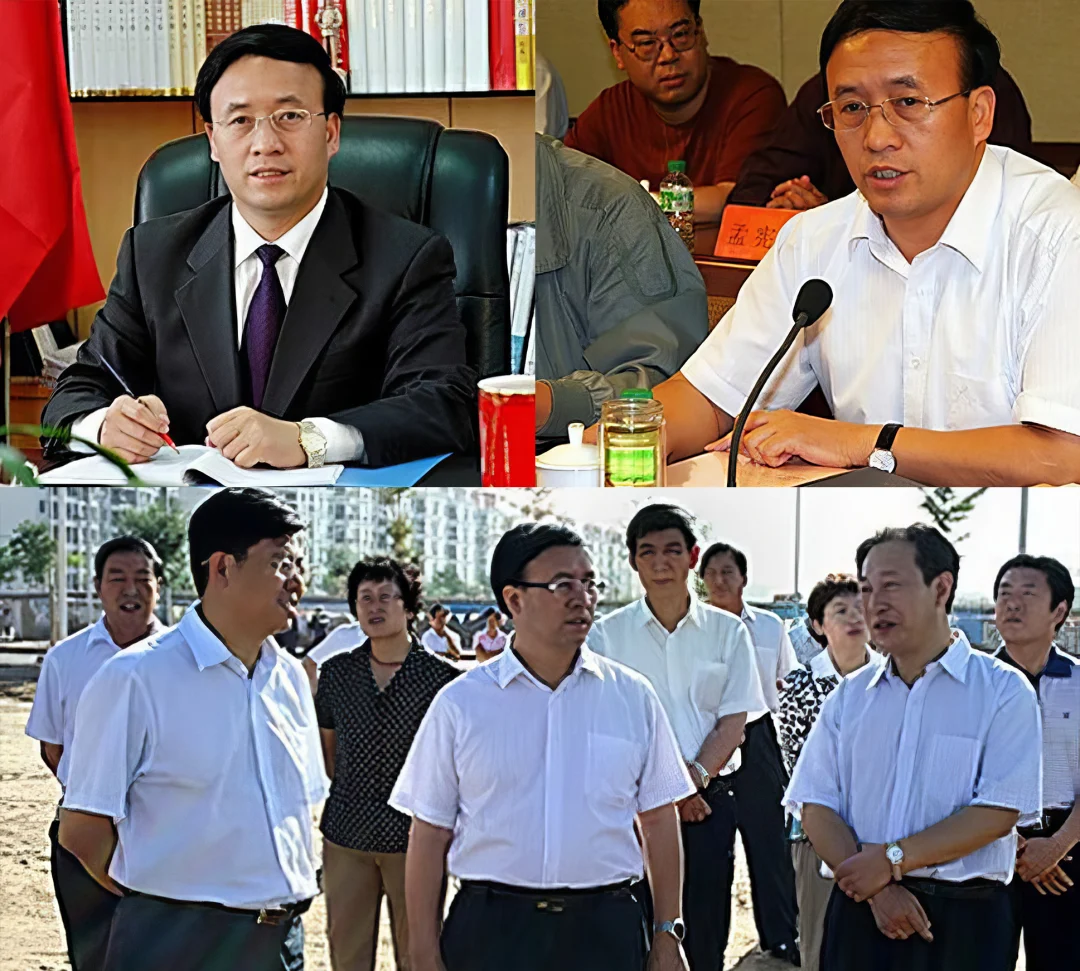
On December 3, 2012, Zhou Lubao reported in his real name on Weibo that Yuan Zhanting, then the mayor of Lanzhou, wore multiple luxury watches, including a diamond-studded Omega estimated at 150,000 yuan and a Vacheron Constantin worth over 200,000 yuan, which caused a public outcry. (Image_Internet)
After his release from prison, Zhou Lubao settled in Haining, Zhejiang, and resumed his old business of writing online articles to help others protect their rights. The posts that the “Lanzhou case” accused him of “repeatedly picking quarrels and provoking trouble” were mainly related to civil disputes such as migrant workers seeking back wages and contractors demanding payment for projects, and tenants seeking the return of security deposits. For each incident, Zhou Lubao wrote multiple articles. Since most of the owed wages and debts involved government projects, he often named the officials responsible. The posts involving criminal charges had readership ranging from a few thousand to over 400,000.
Jing Shuren was an active re-poster of these articles. He had 80 reposts included in the scope of the prosecution's charges, and was deemed an accomplice to the crime of picking quarrels and provoking trouble.
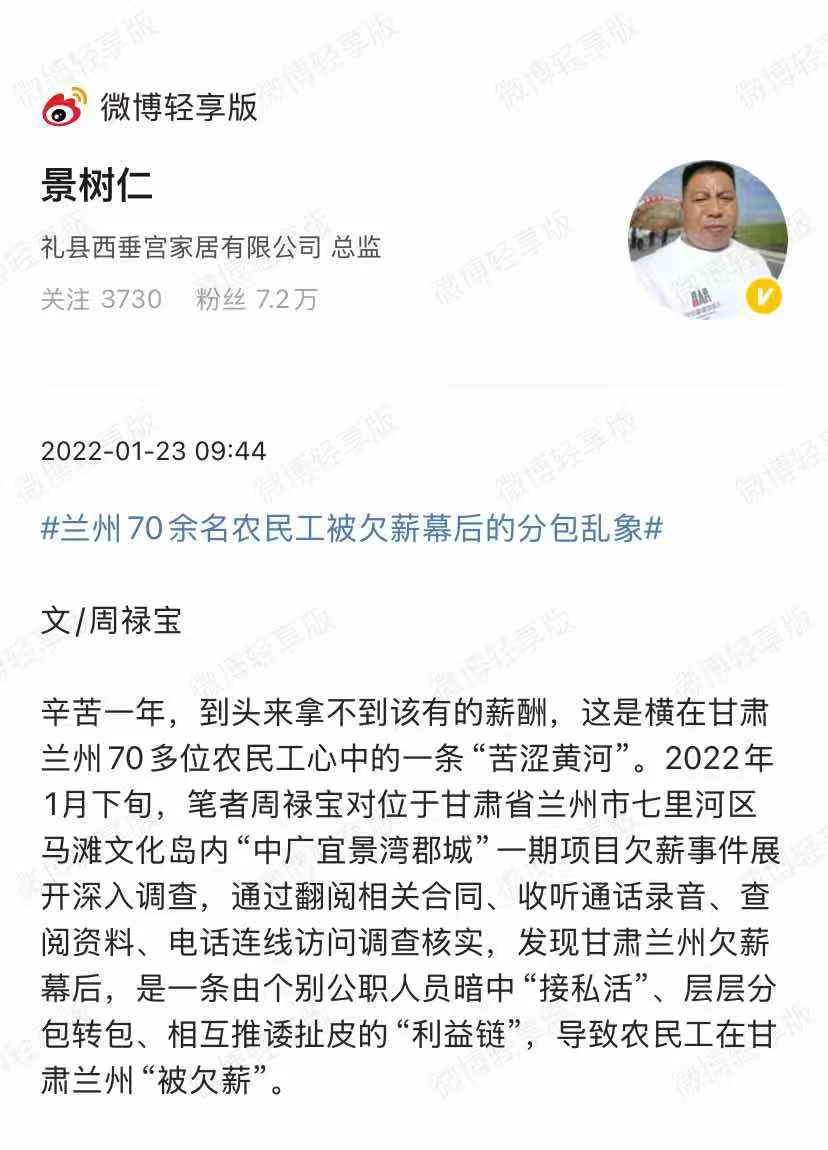
Jing Shuren actively reposted articles written by Zhou Lubao demanding back wages, and this behavior became the basis for the police to determine his involvement in the crime of picking quarrels and provoking trouble. (Image_Weibo screenshot)
Evidence in the case shows that Jing Shuren and Zhou Lubao are distant relatives, and another defendant, Zhou Fangqin, is Zhou Lubao's sister. They introduced several migrant workers seeking back wages to Zhou Lubao. The other four defendants in this case, Ling Sanming, Ling Yanmin, Kang Tianmin, and Li Xueshu, were all parties involved in the back wage disputes. After they recovered their owed payments through Zhou Lubao's posts, they introduced other individuals seeking back wages. Additionally, in 6 other cases involving back wages, the parties involved “contacted him by reputation” and proactively sought out Zhou Lubao.
The prosecution believes that these seven individuals, including the poster and those seeking wages, formed a “criminal chain.” Among them, Zhou Lubao was mainly responsible for “planning, directing, and posting for hype”; Jing Shuren “used his online influence to forward false, negative posts at Zhou Lubao’s arrangement or voluntarily to expand influence and create public opinion pressure”; Zhou Fangqin “was responsible for introducing clients, and at Zhou Lubao’s arrangement, helped collect and forward ‘gratitude fees’ afterward and profited from it”; Ling Sanming and Ling Yanming “actively assisted”“in uploading and downloading, and seeking benefits”; Kang Tianmin and Li Xueshu “repeatedly asked Zhou Lubao to demand disputed engineering payments by fabricating false information, and used negative public opinion to extort property from others.”
On September 11, 2026, the Chengguan District Court of Lanzhou City issued a first-instance judgment, sentencing Zhou Lubao for the crimes of picking quarrels and provoking trouble, and extortion. He was sentenced to fourteen years in prison and fined 120,000 yuan. Jing Shuren was sentenced to four years in prison for picking quarrels and provoking trouble. Ling Sanming was sentenced to three years and ten months in prison for picking quarrels and provoking trouble. Zhou Fangqin, Ling Yanming, Kang Tianmin, and Li Xueshu were convicted of picking quarrels and provoking trouble, and extortion. They were sentenced to three years, two years and ten months, four years, and four years and six months in prison, respectively, and fined. All seven individuals expressed their intention to appeal in court.
The crime lies in “maliciously associating with leaders”; but “does not deny the existence of basic facts”
Zhou Lubao’s posts often mentioned local leaders behind the projects with unpaid wages. Wang Ying, a contractor, was one of the beneficiaries of this strategy. Wang Ying’s testimony shows that an approximately 1 million yuan engineering payment for a relocation project he had undertaken, which had been confirmed by court judgment a year prior, had still not been received. He then contacted Zhou Lubao through Jing Shuren. When he saw Zhou Lubao’s post associating with municipal leaders, he called Jing Shuren and asked him not to include the leaders’ photos. Jing Shuren replied, “If there are no photos, no one will watch; the local government won’t pay attention.” He also told Wang Ying that Zhou Lubao had posted many similar articles before and knew how to handle things appropriately. In the year the posts were made, Wang Ying received the engineering payment. He offered to pay a “hardship fee,” but Jing Shuren declined, citing their hometown relationship and offering to help for free.
The first-instance court held that Zhou Lubao’s “maliciously associating with party committees, governments, functional departments, and relevant personnel of enterprises in the areas where the relevant projects were located,” “collecting ‘gratitude fees’ for huge economic benefits,” and “negative evaluations” that interfered with others’ lives, all constituted elements of the crime of picking quarrels and provoking trouble; furthermore, Zhou Lubao’s act of demanding an additional “compensation fee” to remove the posts after successfully obtaining the wages, with the subjective intent of illegal possession, constituted the crime of extortion.
Du Jiaqian, the defense lawyer in this case, publicly pointed out that association is not inherently good or bad. The so-called “associating with leaders” is essentially reflecting demands and seeking help from leaders. In other words, when the regular channels for addressing demands are blocked and direct communication yields no results, it becomes necessary to convey the predicament through this indirect method to higher authorities. It is essentially “taking a detour” to seek help from public power.
Wu Danhong, a law professor and Zhou Lubao’s defense lawyer, also defended Zhou Lubao in his 2015 “Suzhou case” where he was imprisoned for online posting. Wu Danhong’s publicly released defense statement pointed out that laborers’ claims for compensation in addition to unpaid wages are based on the “Labor Contract Law,” and claiming interest losses due to delayed debt payment is also a claim for statutory fruits, not an arbitrary demand for money.
Zhou Lubao denied in court that the wage-seeking posts he published were fabricated. Onlookers recalled that Zhou Lubao stated in court that due to his previous prison experience, he was particularly cautious about legal boundaries. He claimed that every post he published concerned real wage arrears and that his subjective intention in posting was to help migrant workers who could not get their “survival money.”
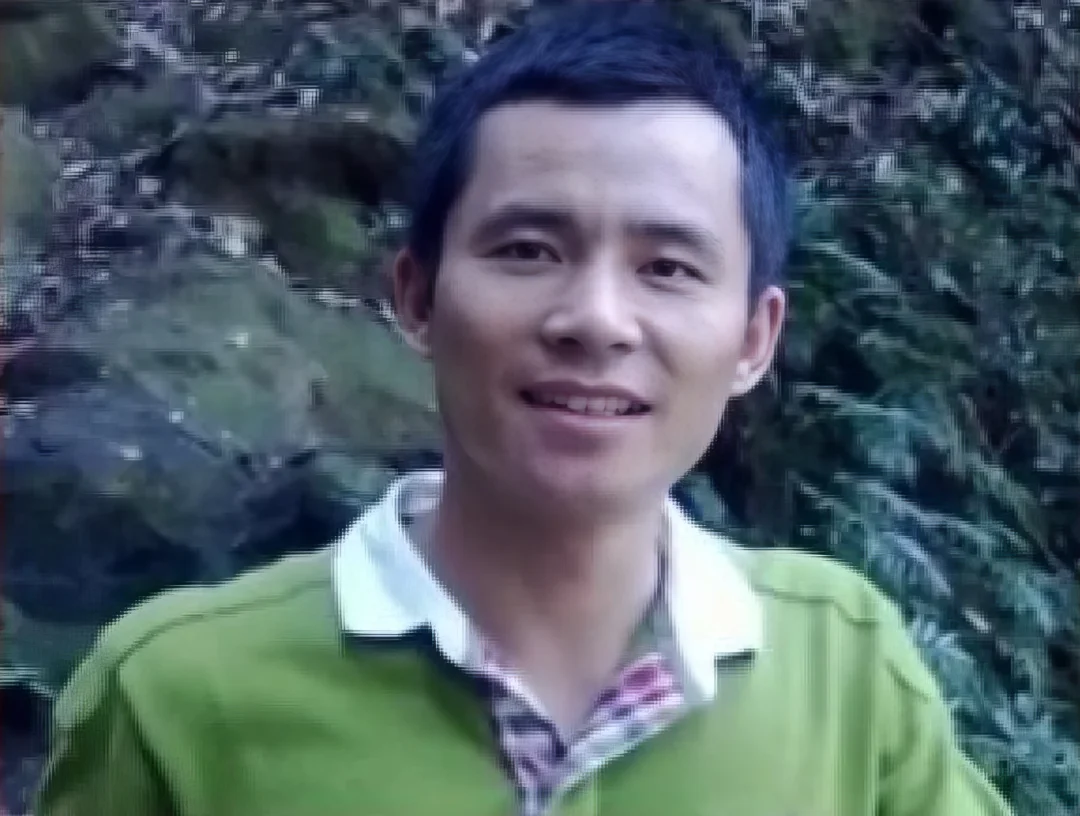
Personal photo of Zhou Lubao cited in media reports in 2013 (Photo_SCMP)
Zhou Lubao stated that before posting, he would usually repeatedly verify the situation with the person seeking help, ask them to provide evidence of wage arrears, such as project settlement statements, IOUs, payrolls, contracts, and inquire about which departments they had previously reported to and what responses they received. He remained cautious about the information provided by those seeking help, sometimes even requiring them to sign an agreement guaranteeing the authenticity of the materials. After obtaining the relevant information, he would also independently investigate the companies involved, find contact information for the boss, the main contractor, and the second-level contractor, and call them one by one to inquire about the situation, fulfilling his verification obligations as much as possible.
Huang Jingyu, the lawyer representing Ling Sanming, a former wage-seeker, pointed out that during the second round of debate in court, the prosecution responded by saying they “do not deny the existence of basic facts,” but argued that “relevant content was packaged and partially true,” and therefore the posts were still considered “false information.” However, he argued that this does not meet the requirements for determining “false information” as stipulated in the judicial interpretation of the crime of picking quarrels and provoking trouble, and cannot be used as a basis for prosecution and indictment.
The first-instance court held that Jing Shuren, “as a self-media individual with a large number of followers, should have a basic duty of care regarding the authenticity of the information he publishes.” Combined with his “long-term, large-scale forwarding of false, negative information and his degree of involvement in individual cases,” it was determined that he “disseminated information knowingly to be false.” Jing Shuren stated in court that he had verified the relevant situation with Zhou Lubao before forwarding posts, and that the platform had not deleted any posts he forwarded, making it impossible for him to discern the truthfulness of the posts.
Among the seven defendants in the Lanzhou case, Zhou Lubao and Jing Shuren only had junior high school education. The other five had basic literacy or were illiterate. What kind of information verification obligation should self-media publishers bear? Du Jiaqian, who defended Jing Shuren, pointed out in court that any article could be scrutinized with a microscope to find one or two inaccuracies. If the forwarder is deemed to have “knowingly disseminated false information” simply because they failed to verify every detail, then ordinary netizens’ daily online expressions could also face criminal risks. “If Jing Shuren is convicted solely for routinely forwarding Weibo posts, then I will surrender myself and report everyone present, including the prosecutors, judges, and bailiffs.”
The trouble originated from reporting a police officer: “Investigating the informant rather than the reported matter”
The investigation and arrest of Zhou Lubao and the other seven individuals stemmed from a market lease dispute.
In November 2021, Liu Xiuqin, a merchant at the Dongbu Market in Chengguan District, Lanzhou City, had her lease expire, but the “landlord” refused to return her performance deposit. Liu Xiuqin and about 30 other merchants with similar experiences negotiated with the management and sought solutions through complaints and petitions, but were unable to get their deposits back. Through her son-in-law’s introduction, Liu Xiuqin sought help from Jing Shuren. After reviewing the relevant materials, Jing Shuren said that a relative of his might be able to help. The “relative” he mentioned was Zhou Lubao. Subsequently, Liu Xiuqin took photos of the relevant materials and sent them to Zhou Lubao.
Starting from March 11, 2023, posts such as “Gansu Lanzhou Rectifies Chaos: Whereabouts of Tenant’s 176,000 Yuan ‘Deposit’ Unknown, No Investigation” and “Lanzhou Shopkeepers Zhu Tianshu and Zhang Weiwen’s Departments Ignore ‘Black Hole’ of Huge Village-Enterprise Treasury” were successively published on Sina Weibo, Baijiahao, Tieba, and Zhihu. The “landlord” reported the matter to the police station.
According to “Xin Huanghe” report, after the post was published, other merchants’ related lawsuits all won in the first instance. Liu Xiuqin later also filed a civil lawsuit, initially lost in the first instance at the Chengguan District Court, and won after a retrial by the Lanzhou Intermediate People’s Court a year later.
Police officers from the police station summoned Liu Xiuqin and Jing Shuren, which led Zhou Lubao to write a letter of complaint to the National Bureau for Letters and Calls and the Gansu Provincial Public Security Department Director’s mailbox on March 20, 2023, alleging that a police officer surnamed Liu from the Chengguan Branch of the Lanzhou Public Security Bureau was putting the cart before the horse, “investigating the whistleblower instead of the reported matter,” and claiming that Liu Xiuqin was a 60-year-old heart patient who had encountered “threats and intimidation” at the police station, demanding to “terminate threats and intimidation, and stop illegal and disciplinary actions.”
Four days later, Zhou Lubao successively published “Zhou Lubao: Wrote a Civil Article, Faced ‘Criminal’ Investigation by Lanzhou Police” and “Zhou Lubao: Faced a ‘Major Investigation’ in Lanzhou After a ‘Major House Search,’ This Time I Must Write to Gansu Director Huang Ruixue,” publicly naming Lanzhou’s “number one police official,” Municipal Public Security Bureau Director Wang Lichao.
Water Bottle Era learned that the “Report on the Handling of Zhou Lubao’s Petition Matters” attached to the case file recorded that the then Director of the Gansu Provincial Public Security Department, Huang Ruixue (deceased), had instructed the then Director of the Lanzhou Municipal Public Security Bureau, Wang Lichao, to handle Zhou Lubao’s petition. Wang Lichao subsequently forwarded it to the Chengguan Branch of the Lanzhou Municipal Public Security Bureau.
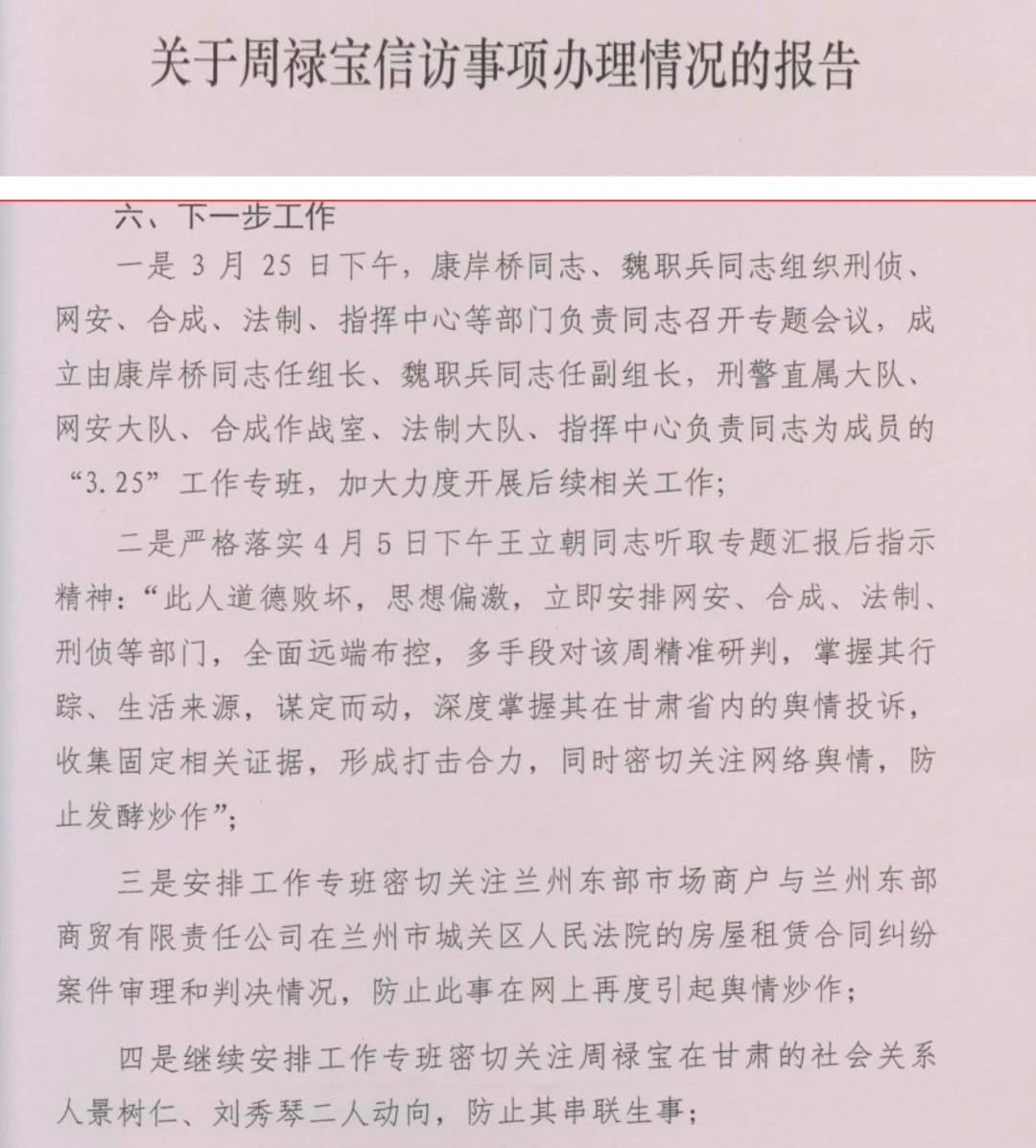
“Report on the Handling of Zhou Lubao’s Petition Matters” attached to the case file (Photo provided by the interviewee)
The case materials show that on March 25, 2023, the Chengguan Branch established a special working group for Zhou Lubao’s petition matter, with members including personnel from departments such as cybersecurity. The group successively sent personnel to Jiangsu, Zhejiang, and other places to carry out “exchanges and research” to collect information on Zhou Lubao’s personal situation, family situation, and social relations. At this time, there were still 7 months before the public security organs made the “Decision to File a Case.”
Police reports show that on the afternoon of April 5, 2023, after listening to a special report, Wang Lichao issued instructions, requiring the immediate arrangement of cybersecurity, synthesis, legal affairs, criminal investigation, and other departments to “comprehensively control Zhou Lubao remotely,” conduct precise analysis through various means, grasp his whereabouts and sources of livelihood, and “act with a well-thought-out plan”; at the same time, he required a deep understanding of public opinion complaints about him within Gansu Province, collection and fixation of relevant evidence, formation of a joint strike force, and close attention to online public opinion to prevent escalation and sensationalism.
Several posts previously published by Zhou Lubao to help others recover engineering debts and wages successively entered the police investigation’s view. Related posts involving Yongchang County, Weiyuan County, Jishishan County, Tianshui City, and other places in Gansu were classified by relevant parties as “false,” “malicious wage recovery,” “maliciously associating with government leaders,” “slandering the government image,” and “sensationalism,” etc.
Public security organs in multiple places in Gansu filed “posting behavior” as criminal cases. After designated jurisdiction, these cases were consolidated to the Chengguan Branch of the Lanzhou Municipal Public Security Bureau. Jing Shuren also subsequently entered the investigation scope of the police special working group.
“Of the 29 Decision to File a Case documents in the case, 25 were dated after the arrest of the 7 defendants. This indicates that the investigation organ had the situation of arresting first and then filing the case,” Wu Danhong pointed out that the normal process of criminal prosecution should be “reporting the case—filing the case—investigation—taking compulsory measures,” while the Lanzhou case presented an inverted process of “leader’s instruction—establishment of a special group—control and arrest—reverse search for a case to supplement filing.”
Zhu Xiaoding, who defended Jing Shuren, also pointed out that before specific clues of Jing Shuren committing illegal and criminal acts were discovered, the special working group established by the Lanzhou public security organs had already included him in the control and investigation scope. The special group also went to other provinces to investigate Zhou Lubao’s personal situation and social relations before the criminal case was filed. These actions exceeded the scope of normal handling of petition matters and were suspected of prematurely exercising investigative powers that should be based on the premise of criminal case filing.
The defense counsel also questioned the handling unit that had previously received the petition. Wu Danhong pointed out that Zhou Lubao’s petition complaint was precisely against the Chengguan Branch of the Lanzhou Public Security Bureau, and subsequently, the Chengguan Branch became the main investigation agency in this case. The online criticism content involved in the indictment also pointed to its relevant departments and personnel. “The public security organ that was previously complained about and criticized continues to undertake the investigation work, which has a clear conflict of interest and may affect the impartiality of the case handling.”
The above viewpoints were not supported by the first-instance court.
“Ling Sanming’s Question”: “How did those who owe us wages become the victims?”
In the view of the defense lawyers, the four former wage claimants involved in this case did not choose to post online to claim wages from the beginning. It was only after repeatedly complaining to the labor inspection department and the petition department that their problems were never resolved, that they turned to seek help online.
Wu Danhong listed in the defense opinion: Before contacting Zhou Lubao, Ling Sanming had complained to the Chengguan District Labor Inspection Department of Lanzhou City. The labor inspection department had sent a letter to Beijing Urban Construction, but received no reply; Kang Tianmin had repeatedly reported the wage arrears problem to the Tianshui City Labor Bureau and the Maiji District Petition Bureau. The Tianshui Municipal Government had even listed the Outlets project as a major wage arrears project; Du Xingbing had repeatedly complained to the Xunshan County Labor Inspection Brigade and the Petition Bureau; Li Xueshu had complained to the Chengguan District Labor Inspection Brigade. The labor inspection department had coordinated multiple times, but the problem remained unresolved.
A defense counsel recalled that Ling Sanming recounted his wage claim experience at a pre-trial conference held in April this year: As the Spring Festival approached, his fellow workers gathered around him, hoping he could help them get their wages back. He dared not go home because he had no money and did not know how to face his family and fellow workers. Just as he was at a loss on how to claim his wages, he received a phone call: a migrant worker who was also owed wages, after bidding farewell to his two children, drank pesticide and committed suicide. He died after rescue efforts failed.
Ling Sanming described himself as being “at the end of his rope” at the time, and could only ask someone he knew to help write the wage claim post. The wage arrears problem, which had not been resolved after months of running around, took a turn for the better on the third day after the post was published: the head of the company that owed wages flew from Beijing to Lanzhou. As soon as he got off the plane, he proactively contacted them and expressed his willingness to resolve the wage arrears issue.
He expressed his confusion about the charges in the case: “We just wanted to get our wages back, where did we go wrong? How did those who owe us wages become the victims?”
Zhu Xiaoding, who defended Jing Shuren, called this question “Ling Sanming’s Question.” Kang Tianmin, a former wage claimant, also said in court that he had repeatedly gone to the labor bureau and the petition office in 2021 and 2022, but no one ever handled the wage arrears problem. “I couldn’t go home on the 23rd of the twelfth lunar month,” he said. In the cold winter, the blood and sweat money of more than a hundred migrant workers was still being withheld. If Zhou Lubao had not posted to help, he might have jumped off a building.
Du Jiaqian also talked about the family situation of another defendant, Ling Yanming, in court. Ling Yanming is a construction worker who works more than twelve hours a day, toiling on the construction site regardless of the severe cold or heat. He has four children, and his wife needs to take care of the family. The living expenses of the family of six and the education expenses of the children, as well as the support expenses for both sets of parents, all rely on his income.
Zhu Xiaoding pointed out that the continued detention has led to the problem of children of Zhou Fangqin and Ling Yanming being out of school. Some migrant workers also reported that when they were asking for wages, employers mentioned the detained defendants and threatened them not to “make trouble.”
Jing Shuren said in court that he had personally experienced the helplessness of not being paid, so when he saw the Weibo about migrant workers not being paid, he wanted to help them solve the problem. He also mentioned that he had donated money to patients with pneumoconiosis, rescued fellow villagers who were misled into pyramid schemes, and helped farmers sell unsalable apples, saying, “I seek no reward, only a clear conscience.”
The post author and 7 people demanding wages are imprisoned, while those outside still believe that “shouting out” will bring about a turning point and continue to name local officials. On November 17, veteran media person Chu Zhaoxin publicly wrote a letter to Wu Xiaojun, Secretary of the Gansu Provincial Party Committee, calling for attention to the case. In his letter, he called Jing Shuren a “good man of Gansu” and believed that he was willing to risk helping others voluntarily despite knowing the potential criminal risks, saying, “As someone who has attended university and worked as a reporter for more than ten years, I cannot do this.” At the end of the letter, he wrote: “History will record, and the people will remember.”
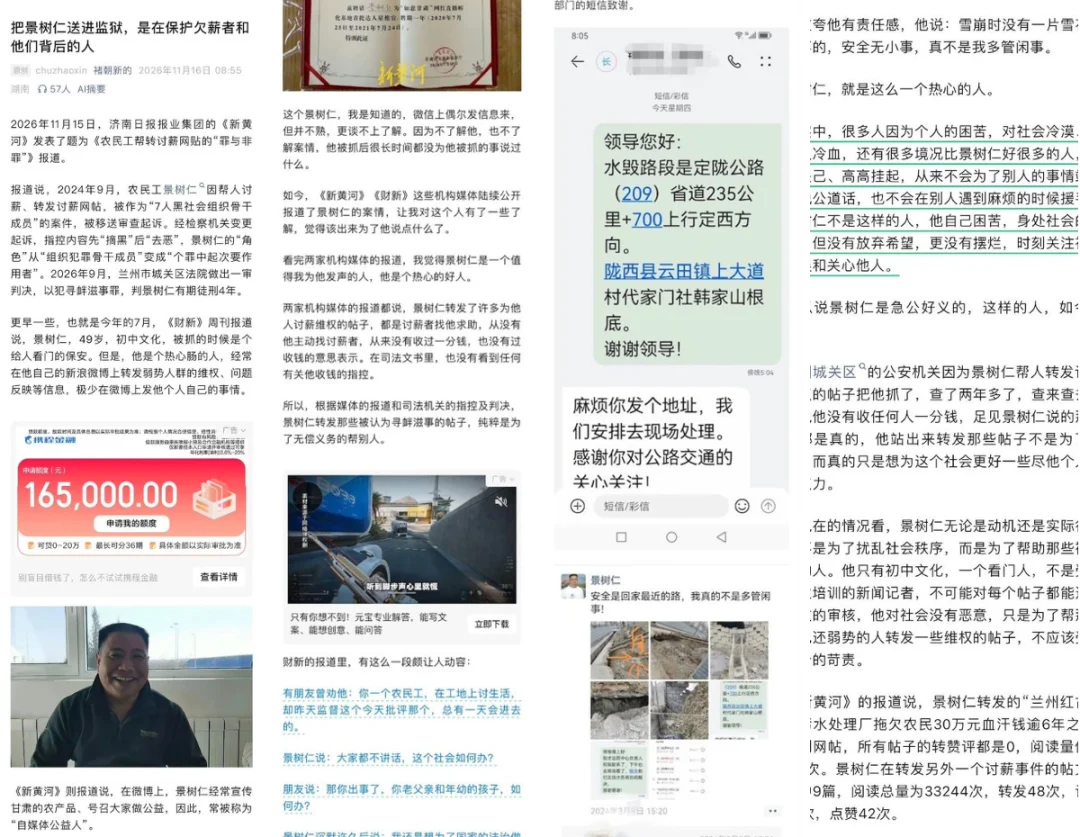
Veteran media person Chu Zhaoxin posted an article on his WeChat public account in support of Jing Shuren (Image_Network)
Zan Zuolong, who once served in the CPC Cheng County Committee in Gansu, also publicly wrote a letter to Wu Xiaojun, expressing his concerns about the case and the boundaries of the rule of law. Du Jiaqian publicly wrote a letter to He Li, President of the Gansu High People's Court, requesting that judicial organs “have the common people in their eyes and see the hardships of the people.” The self-media account “Tingshenshi” wrote a letter to the Lanzhou Municipal People's Government and relevant cyberspace administration and judicial authorities, calling for attention to public opinion.
The above open letters and articles are now no longer visible. The defense lawyer told Shui Ping Ji Yuan that on September 26, the Lanzhou Intermediate People's Court urged the defense counsel to submit their defense statements as soon as possible, and there was a possibility that the second instance would be tried without a hearing and the original judgment would be upheld. On November 2, six defense lawyers went to the Lanzhou Intermediate People's Court to express their strong desire for a hearing. The court stated that it would study the opinions of the defense counsel.