

I've been a bit busy lately and haven't had time to write for my public account, but seeing the People's Daily article “'Pension Collapse Imminent'? Navigating Cognitive Fog with 'Three Accounts' | People's Daily Commentary” made me laugh with anger. Especially that “fairness account”:
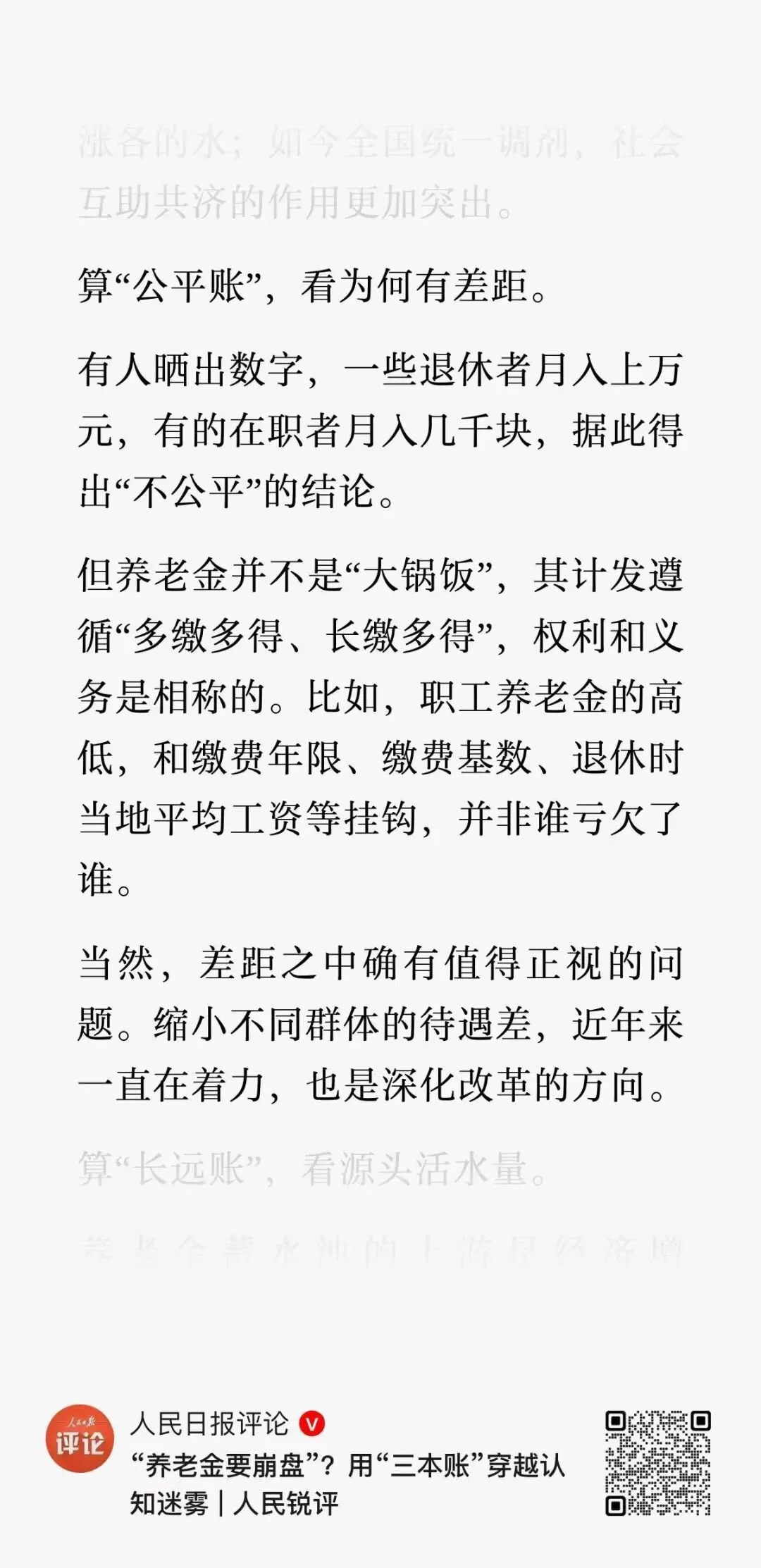
Didn't this just walk into my gun muzzle? For the past two years, I have written forty to fifty articles on this very topic, discussing fairness, fairness, fairness. I wrote three sentences on the “fairness account,” let's take them one by one. 1. “Someone posted numbers, showing that some retirees earn over 10,000 yuan per month, while some active employees earn a few thousand yuan per month, and from this, they conclude that it is ‘unfair’.” They are talking about the “system,” not “some retirees,” can you be clear? If you are in a private enterprise and earn that much, it's fine, that's what they earned through their own intelligence and hard work. Those in the system are supported by taxpayers, is it appropriate to earn so much? Moreover, this is not “some,” but a common phenomenon: statistical data from multiple provinces shows that the average retirement pension in the system is higher than the average salary in private enterprises. Can you stop being vague and avoiding the important issues? This kind of rhetoric is not about seeing through the “fog of cognition,” but about creating the “fog of cognition.” More importantly, why don't you talk about the income gap between different retirement groups? Don't avoid it, tell me how much the 180 million urban and rural residents (the vast majority of whom are farmers) receive per month?
01 Income Situation
Average pension for those in the system: over 6,000 yuan/month
Average pension for enterprise employees: over 3,000 yuan/month
Average pension for urban and rural residents (farmers): over 200 yuan/month
Monthly income ratio: 30:15:1
Peng Yuanwen, “5 Common Sense Facts Everyone Should Know About China’s Pension System.” This is the first of my “Five Common Sense Facts,” based on statistics from official public data in 2023. The figure for the average pension for those in the system being over 6,000 yuan/month uses the most conservative calculation method. If we consider the replacement rate (the ratio of pension received to pre-retirement wage income), it looks like this:
04 Replacement Rate
The replacement rate for those within the system exceeds 80%, far exceeding the world average and high-welfare Nordic countries.
The replacement rate for enterprise employees is around 40%, below the world average.
The replacement rate for urban and rural residents (farmers) is around 10%, which is insufficient to solve the problem of basic needs.
Peng Yuanwen, “5 Common Sense Facts Everyone Should Know About China’s Pension System”
Please note that the replacement rate is the ratio of pension to current income. The 10% replacement rate for farmers is based on the fact that the per capita disposable income of rural residents is about 43% of that of urban residents. Some may argue: Farmers do not retire, they have to work even at eighty, where is the ratio of retirement and current income? Well, you could say that too.
2. “But pensions are not ‘one size fits all’; their calculation follows the principle of ‘more contributions, more benefits; longer contributions, more benefits,’ and rights and obligations are commensurate. For example, the level of employee pensions is linked to the number of contribution years, the contribution base, and the local average wage at retirement, and no one owes anyone.” Don’t use “more contributions, more benefits” as a guise. First, “more contributions” is wrong because it is borne by taxpayers; the more you contribute, the heavier the burden on taxpayers. The excessively high contribution rate of China’s pension insurance itself is a problem, and many private enterprises cannot afford it. Then, “more benefits” is also wrong, because a large part of it is fiscal subsidies. I have also written specifically about this:
The reason why China’s pension system is unfair lies in the four words “more contributions, more benefits.”
Because once fiscal subsidies are involved, this statement is completely wrong. If you buy commercial pension insurance, this statement is correct; if it is employee pension insurance that does not involve fiscal subsidies, this statement is also fine; however, the reality in China is that fiscal subsidies are ubiquitous, so in the Chinese context, this statement is extremely erroneous.
In other words, as long as fiscal subsidies are involved and taxpayers’ money is spent, we must count heads and implement absolute “egalitarianism”: everyone gets a share, and everyone gets the same amount, no more and no less. The current problem in China lies in “more contributions, more benefits”: the more you contribute, the more subsidies you get, the higher your pension, and the greater the disparity.
Peng Yuanwen's "Why can't pensions be 'pay more, get more'?"
So, what is the actual situation of China's fiscal subsidies for pensions for different groups?
02 Fiscal Subsidies
Fiscal subsidies for different groups in 2023:
0.22 billion people in the system subsidized 805.6 billion yuan, averaging 3051 yuan/month
120 million enterprise employees subsidized 762 billion yuan, averaging 529 yuan/month
173 million urban and rural residents (farmers) subsidized 368.1 billion yuan, averaging 177 yuan/month
The subsidy ratio is: 17:3:1
Peng Yuanwen, “5 Common Sense Facts Everyone Should Know About China’s Pension System”
What about the fiscal subsidies for pensions in other countries? As far as I know, there are only two situations: 1. Absolute egalitarianism, everyone gets the same amount; 2. Robbing the rich to help the poor, the higher the income, the less the subsidy, until it becomes zero. Like China, where the higher the income, the more the subsidy, and the highest subsidy for people in the system is 17 times that for farmers with the lowest income. I am ignorant and have never heard of such a thing.
3. "Of course, there are indeed problems within the gap that need to be faced squarely. Narrowing the treatment gap between different groups has been a focus in recent years and is also the direction of deepening reform." Well, is it that urban and rural residents get a 20 yuan increase every year?
03 Growth Situation
From 2009 to 2023,
the monthly pension for those within the system increased from over 2,000 yuan to over 6,000 yuan, an increase of about 4,000 yuan, with an annual increase of about 285 yuan.
the monthly pension for enterprise employees increased from over 1,000 yuan to over 3,000 yuan, an increase of about 2,000 yuan, with an annual increase of about 140 yuan.
the monthly basic pension for urban and rural residents (farmers) increased from 55 yuan to 223 yuan, an increase of 168 yuan, with an annual increase of 12 yuan (more than half of the provinces have less than 150 yuan, with an annual increase of about 6 yuan).
Peng Yuanwen, “5 Common Sense Facts Everyone Should Know About China’s Pension System”
I don't know how People's Daily calculated their figures in that commentary. You should at least speak with data like I do—what kind of accounting is done without data? Unfortunately, most of the forty to fifty articles I previously wrote on this topic cannot be opened. Originally, this article could have been completed with a hyperlink, but now I can only complete it by copying and pasting.
The articles I could retrieve have been backed up to “Knowledge Planet”. Friends who want to read them can subscribe:

As for the other two calculations in that People's Daily article: the “structural account” and the “long-term account”, I am too lazy to refute them. In fact, I agree with them. Just the other day, I was refuting a group member in the chat:
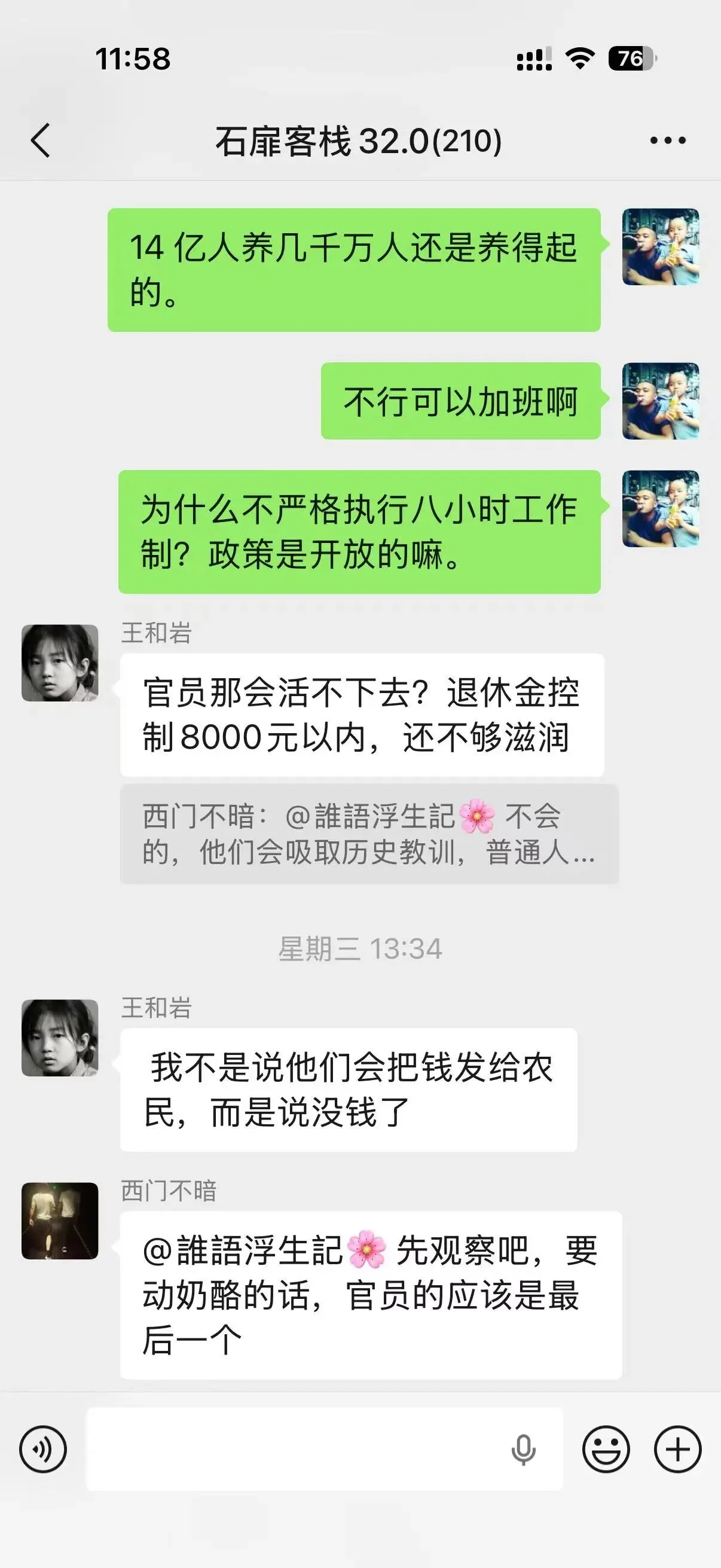
As a result, this friend picked on me, saying that the retired population is not 1.4 billion people:
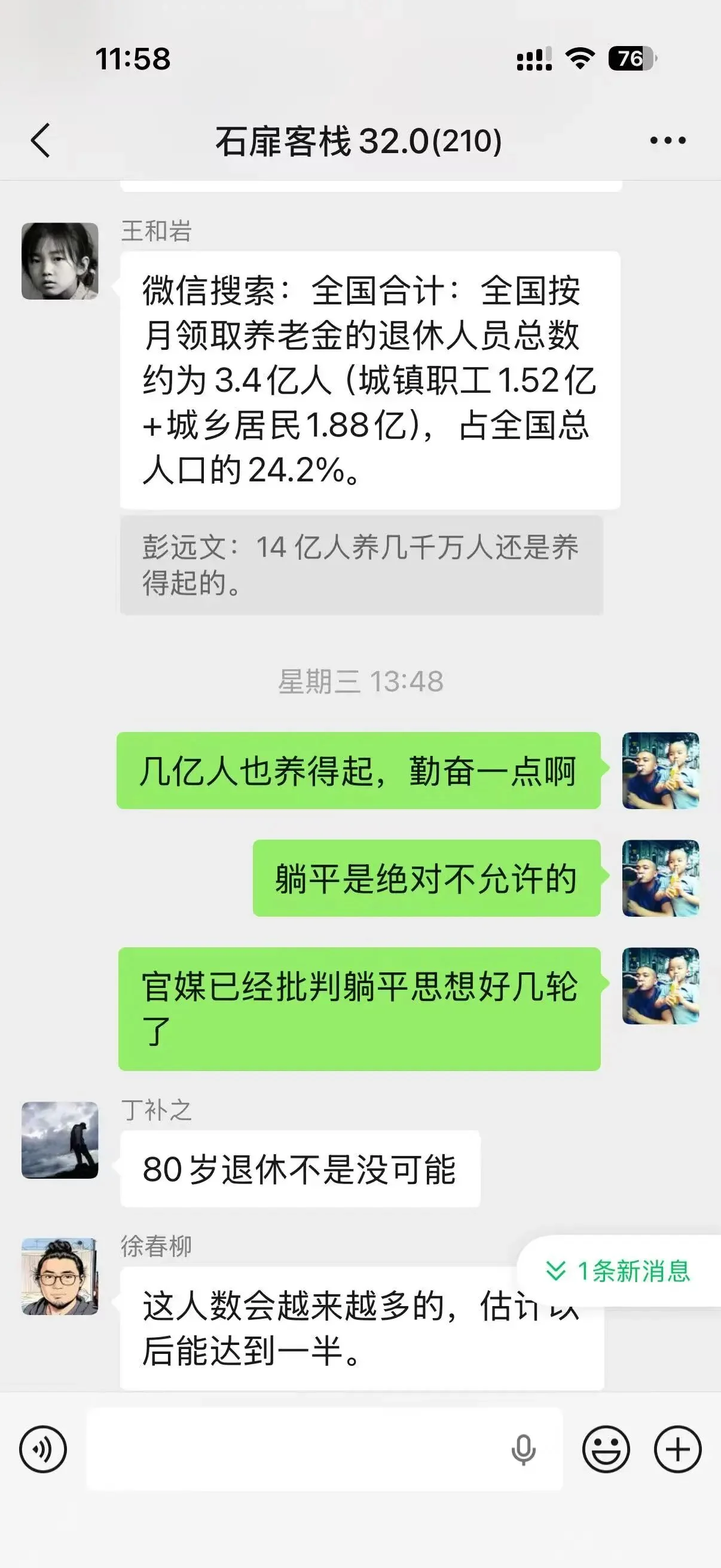
Alright, we're done. Everyone should get back to work. If you don't work and I don't work, who will pay the pension insurance?